Online hospitality training: build leadership skills and specialized expertise from anywhere
19th December, 2025

In this article
- What online hospitality training offers
- Cost effective compared to relocating or full-time
- Access to global expertise from home
- Online certificates to consider
- How hospitality training online supports career mobility
- Strategic management roles
- Specialist and departmental roles
- Entrepreneurial pathways
- How to choose the right online hospitality course
- What to expect when studying hospitality training online
- Why study online with Les RochesHeading Example
- Conclusion
Online learning has changed the way people develop in the hospitality industry. Hospitality courses delivered online give professionals a way to build new skills without leaving their jobs or relocating to a campus.
They also give early career students, career changers and experienced managers the chance to deepen their knowledge at a pace that fits real life.
What once required long programs and travel can now be achieved through focused courses, guided learning and practical online sessions.
Modern hospitality training covers every part of the industry from hotel management and food and beverage operations to digital marketing, revenue management and guest experience.
It also gives learners access to industry expertise, case studies and development tools that help them apply what they learn straight away.
This guide explains what you can learn through hospitality training online, how executive courses differ from certificates and how to choose the path that supports your goals. Whether you want to progress into leadership, specialise in a technical area, build confidence in core hotel operations or understand the wider industry, online learning offers a clear way forward.

What online hospitality training offers
Online hospitality training combines flexible delivery with industry-relevant content to support professional development across different career stages.
Why professionals are choosing hospitality training online
More people are turning to hospitality training online because it makes development possible at any career stage. It works for managers who want to progress, for specialists who need specific skills and for newcomers who want to understand how the industry works. It also gives people a way to build recognised hospitality certifications that support career moves into hotels, resorts and wider service industries.
Flexible learning that fits demanding schedules
This flexibility is one of the strongest reasons professionals choose online hospitality training.
Online programs allow you to study without leaving your role or changing your daily routine. You can learn in focused blocks or in shorter sessions during the week. The learning fits around your life rather than the other way around. Many platforms now offer mobile friendly modules and short microlearning lessons that help learners build momentum even with limited time.
A cost effective alternative to full degrees
Traditional study often involves housing costs, relocation and long periods away from work. Online hospitality training removes these barriers. Courses are shorter and designed to deliver clear value. This format helps people learn new skills without taking on a large financial commitment. It also makes professional development possible for people who want to test a new area such as hotel operations or food and beverage management before committing to a full degree.
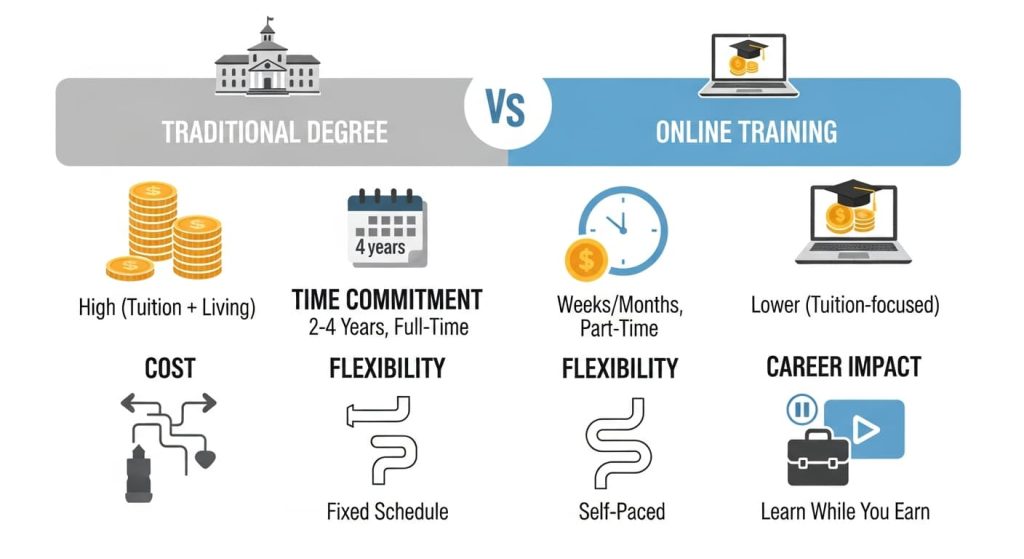
Cost effective compared to relocating or full-time, in-person study
Online hospitality programs are often more affordable than traditional campus programs. When you factor in savings on travel, housing and tuition, you get substantial value without compromising on course quality or accreditation.
Access to global expertise from home
Online training connects students with faculty who have worked in international hotels, resorts and tourism businesses. It also gives access to real case studies and industry examples. Some programs include guest speakers from investment groups, tourism boards and leading hotel brands. This mix helps learners understand how decisions are made inside modern hospitality organizations and what is needed to advance into strategic roles.
Training that builds confidence in real workplace environments
The best online hospitality courses are structured to support learning that can be applied immediately. Many students find that the online format helps them link theory with practice because they continue working while they study. This combination strengthens learning and gives a clearer path to progression into roles such as guest service, events, hotel management or food and beverage supervision.
Two learning paths: executive courses and online certificates
Today’s online hospitality training usually falls into two clear paths. One is designed for managers and leaders who want focused development. The other supports people who want practical skills or specialist knowledge they can build at their own pace.
Executive online courses
Executive online courses suit mid level and senior professionals who want short, intensive training led by faculty. These courses last around three weeks and include live sessions, interactive group work and case study discussions. They allow learners to upgrade their skills quickly without stepping away from their roles.
Typical executive course themes include:
- Financial analysis
- Property valuation
- Revenue and demand planning
- Sustainable development in hospitality
Each topic focuses on strategic decision making. Students learn how to interpret financial statements, understand investment principles, analyze performance data and plan for long term growth. For some, the aim is to progress into general management. For others, the goal is to understand the technical side of hospitality performance.
You can view the full list of executive online courses here.
Learn from global hospitality experts and enjoy the flexibility to study anywhere. Discover how an online hotel management executive program can help you lead from day one.

Online certificates
Online certificates are designed for students who want targeted skills or a clear foundation in hospitality. These programs are self paced and focus on the practical areas needed in modern hospitality teams. They suit early career learners, career changers and professionals who want to specialize in digital marketing, sustainability, finance or service excellence.
Typical certificates include:
- Hospitality finance analyst
- Digital marketing
- Maitre d training
- Sustainability specialist
Each certificate offers focused learning across several modules. Students can work through the material when it suits them and build skills one step at a time. You can explore all online certificates here.
Main Image – gettyimages Credit: damircudic
Gain targeted hospitality expertise through modular online certificates designed to fit your professional life

Core skills gained through hospitality training online
Online hospitality programs develop skills across leadership, operations, and commercial performance.
Online hospitality training covers a wide mix of technical, operational and leadership skills. These skills support progression into supervisory, managerial and specialist roles across the sector, and help learners build confidence in areas that directly shape hotel performance.
Strategic finance and analytical decision making
Finance is central to senior hospitality roles. Online courses teach students how to read financial statements, understand budgets and interpret performance indicators. They also introduce the principles of valuation, capital investment and forecasting. Some programs include case studies on asset management and hotel real estate so learners can see how financial decisions drive growth. These skills help managers make stronger decisions and prepare for director level responsibilities.
Revenue and demand planning
Hotels and hospitality businesses depend on accurate forecasting. Online hospitality training explains how to model demand, plan capacity, understand booking behavior and manage pricing. Students learn how to use revenue management systems and see how forecasting supports long term performance. These skills are essential for roles in revenue management and commercial strategy.
Guest experience and service leadership
Service sits at the heart of hospitality. Online courses explore how to design memorable experiences, manage service standards and build effective communication skills. The training also introduces methods for understanding guest expectations, managing feedback and improving team performance. These skills apply across hotels, restaurants and service focused businesses and are central to roles in guest relations and front office management.
Digital marketing and commercial growth
Modern hospitality relies on strong digital visibility. Students learn how search engines work, how to plan digital content and how to shape online journeys that support guest bookings. The training also covers social media and email communication, and the tools that help brands maintain a consistent presence online. These skills support careers in digital marketing, sales and commercial development.
Sustainability and responsible operations
Sustainability is becoming a key priority for the sector. Online courses introduce topics such as energy management, ethical purchasing and water efficiency. Students learn why sustainable practices support better performance and how they shape the reputation of hotels and tourism businesses. These skills support roles focused on ESG leadership and operational improvement.
Food and beverage operations
Many online programs include modules on menu planning, cost control, service flow and food safety. Learners gain an understanding of how kitchens, bars and restaurants operate and how to manage teams in fast paced environments. This knowledge supports entry into F&B management and supervisory roles.
Human resources and people management
Strong hospitality teams depend on effective leadership. Online training often covers recruitment, staff development, conflict resolution and performance management. These skills help new managers build confidence when leading diverse teams and support progression into HR or training focused roles.
Technology, systems and property operations
Hospitality is increasingly driven by digital systems. Students are introduced to property management systems, reservations software and front office tools. They also learn how technology supports housekeeping, maintenance and safety standards. Understanding these systems is useful for roles across hotel operations and administration.
Executive online courses in detail
Executive online courses allow students to build advanced knowledge in a short period of time. Each course focuses on a core area of strategic management and applies real cases from hotels and tourism projects.
Hospitality financial analysis
This course helps professionals understand financial statements, cost structures and performance indicators. It shows how to use financial insights to guide decisions and improve results. Students learn how to analyze budgets, review investment options and understand the financial side of property operations. These skills prepare managers to take on broader responsibilities across departments.
Hotel valuation and performance
This course explains how properties are valued and what drives long term performance. Students learn about market analysis, income methods and the factors that influence property value. This training is useful for managers involved in planning, investment, development or asset management.
Hospitality revenue and demand management
This course introduces the principles behind forecasting, capacity planning and revenue optimization. Students learn how booking patterns shape demand, how pricing models work and how to plan distribution across channels. Case studies help learners understand how small decisions influence overall performance. These skills are essential for roles in revenue management and commercial strategy.
Sustainable hospitality and tourism development
Sustainability now influences investment, guest expectations and long term growth. This course introduces ideas that support responsible operations. Students explore topics such as circular economy principles, energy and water planning, community impact and sustainable design. The aim is to help managers use sustainability as a practical tool that strengthens both performance and guest satisfaction.
Course summary:
The table below summarizes the focus, expertise, and time commitment of each executive online course.
| Executive Course Focus | Key Areas of Expertise | Time Investment & Format |
| Hospitality Financial Analysis | Develop expertise in financial accounting, preparing financial statements, and enhancing shareholder value. | 3 weeks, Live Sessions, Peer Networking |
| Hotel Valuation and Performance | Master key valuation techniques, property assessment, and contemporary value drivers (e.g., brand value, data management). | 3 weeks, Live Sessions, Peer Networking |
| Hospitality Revenue and Demand Management | Apply principles and implementation of revenue management, capacity planning, and demand forecasting through case studies. | 3 weeks, Live Sessions, Peer Networking |
| Sustainable Hospitality and Tourism Development | Integrate the circular economy, Corporate Social Responsibility (CSR), and quality of life as strategic tools for growth. | 3 weeks, Live Sessions, Peer Networking |
Accelerate Your Hospitality Leadership Career
Advance your skills in just 3 weeks with faculty-led courses on strategic finance, revenue management, and valuation.
Online certificates to consider
Certificates offer a flexible alternative for learners who want targeted, practical expertise without live sessions.
Online certificates offer a different path. They focus on building targeted expertise and can be completed at a pace that fits each learner. Many students choose certificates to support a career pivot or to gain skills in an area their current role does not cover.
Hospitality finance analyst certificate
This certificate provides a clear foundation in hospitality finance. It covers financial reporting, budgeting, forecasting and capital investment. The modules help learners build confidence when handling financial data and support progression into analyst roles or supervisory positions where financial understanding is required.
Digital marketing certificate
Digital communication is central to hospitality growth. This certificate explains how to improve visibility, shape online journeys and develop content that supports brand identity. Students learn how to use search engine optimization techniques, manage digital channels and measure marketing performance. These skills help teams attract guests and maintain loyalty.
Maitre d certificate
This certificate focuses on service excellence and high standards of guest care. It includes training in communication, table service, bar service and the soft skills needed to manage guest expectations. Students learn how to oversee the flow of service, guide a team and manage challenging situations with confidence. It is suitable for those progressing in restaurants, events or guest facing departments.
Sustainability specialist certificate
This certificate supports learners who want to understand the operational side of sustainable hospitality. It covers energy management, eco friendly purchasing, water planning and sustainable landscape design. Students learn how to create responsible processes that reduce impact while improving the quality of guest experiences. These skills support roles in operations, development and ESG focused departments.
Build specialist skills with an online certificate
Gain foundational expertise in finance, marketing, or sustainability with a self-paced specialist course.
Explore all specialist certificates
How hospitality training online supports career mobility
Online learning provides a direct path to new roles because the skills taught are grounded in real operational needs. Many learners use executive courses and certificates to prepare for promotions or move into new areas of responsibility.
Choosing the right course becomes easier when you follow a structured decision process.
Strategic management roles
Skills gained through financial analysis, valuation and revenue planning support progression into general management, operations leadership and commercial roles. Many managers find that understanding the technical side of performance helps them communicate better with senior stakeholders and guide teams more effectively.
Roles that benefit from this training include:
- General manager
- Director of operations
- Director of finance
- Revenue manager
- Asset manager
Students can explore career paths through this hospitality careers guide.
Specialist and departmental roles
Certificates help learners move into areas that require focused knowledge. Digital marketing, sustainability and finance are common pathways for professionals who want to build specialist expertise that stands out in a competitive environment.
Specialist roles include:
- Finance analyst
- Sustainability coordinator
- Maitre d or restaurant supervisor
- Digital marketing officer
- Guest experience coordinator
These positions often lead to broader responsibilities as teams rely more on technical skills and data driven decision making.
Entrepreneurial pathways
Online hospitality training can also support people who want to launch their own ventures. Understanding finance helps future owners plan budgets and investment. Revenue knowledge supports pricing and forecasting. Service training strengthens guest experience design. Sustainability knowledge helps new businesses attract responsible travelers and meet modern expectations.
Entrepreneurial paths include:
- Boutique hotel concepts
- Restaurants or bar operations
- Tourism and experience design
- Hospitality consultancy
- Event planning businesses
How to choose the right online hospitality course
Choosing the right program depends on your goals, your schedule and the type of learning that works best for you. The decision becomes easier when you break it down into a few simple steps.
Define your current stage
Start by understanding where you are now and what you want to achieve. Managers who need strategic skills will benefit most from intensive faculty-led executive courses. Early career learners, career changers or professionals looking to build a specific skill often prefer online certificates because they offer clear structure and a practical focus.
Consider your time and routine
Your daily routine plays a big role in shaping the right choice. Executive courses require a concentrated three-week commitment with live scheduled sessions. Certificates offer full flexibility and allow you to work through modules in shorter blocks over a longer period. This format suits people balancing irregular hours or busy operational roles.
Understand your learning style
Think about how you learn best. Live interactive classes are ideal if you value discussion, real-time feedback and collaboration. Self-paced modules work well for independent learners who prefer to absorb information in their own time and revisit material when needed.
Match the course to your goals
Choose a program that aligns with your next step. If you are preparing for a role with strategic responsibility, an executive course in finance, leadership or revenue management will give you the depth you need. If you want to build a specific skill for a specialist role, a certificate that targets that area is a better fit.
Review your budget
Online programs are significantly more affordable than full-time degrees. Executive courses are a focused investment in high level leadership development. Certificates offer structured learning at a lower cost, making them an accessible way to build skills without long-term financial commitment.
What to expect when studying hospitality training online
Online hospitality training is built around active learning. It combines industry insight with practical tools students can use straight away.
Live sessions
Executive courses include real-time teaching and group discussions. Students work through cases with faculty, exchange ideas and gain perspectives from peers working in hotels, restaurants and tourism organisations around the world.
Digital tools
Modern platforms support collaboration and engagement. Students can access recorded sessions, assignments, reading materials and assessments through a central portal.
Online learning is widely used in the industry itself, with many hotel groups training staff through digital modules for onboarding and compliance.
AI-driven tools are also becoming part of the learning experience, helping students review concepts, practise exercises and build confidence through interactive study methods.
Group work
Many projects involve teamwork. This approach develops communication, problem-solving and leadership skills and exposes students to the diverse operational realities of the global hospitality sector.
Real world cases
High quality programs use case studies from real hotels, resorts and tourism businesses. These examples help students link theory with daily operational challenges and understand how decisions are made in modern hospitality environments.
Academic support
Students are supported throughout their studies. They can contact faculty with questions, participate in discussion forums and access academic guidance when needed. This support helps maintain motivation and reduces the isolation that can sometimes occur in online learning.
Why study online with Les Roches
Les Roches offers a mix of executive courses and certificates that support development at every stage of a hospitality career. Programs balance academic knowledge with practical application, and faculty bring experience from global brands, independent hotels and major tourism projects.
The alumni network spans more than 100 countries and gives learners access to a broad community of professionals.
The online format helps students stay active in their current roles while building the skills needed for leadership. It also opens opportunities for people who cannot relocate or take long periods away from work, offering a flexible and accessible path to high quality hospitality education.
Conclusion
Hospitality training online gives you the chance to build meaningful skills without stepping away from your career. The flexibility of executive courses and certificates means you can study at a pace that suits you. You can strengthen your financial knowledge, improve your service skills or gain confidence in digital tools. You can prepare for a promotion, change direction or build a new business idea with a clear understanding of how the industry works.
Online learning removes distance and makes development accessible wherever you live. With practical content, global faculty and flexible formats, you can progress in a way that aligns with your ambitions.
Find Your Online Hospitality Course Path
Speak with an expert to clarify your best path: Executive Course (faculty-led) or eAcademy Certificate (self-paced)
Explore online learning
World class hospitality Education, delivered online
Whether you are building a foundation with specialist certificates or leading change with executive-level programs, find the flexible path that matches your professional goals
Explore online learning
Related industry news

Industry News

Hospitality Careers
High paying jobs in hospitality: what to expect and how to prepare yourself

Industry News
Hospitality Careers
High paying jobs in hospitality: what to expect and how to prepare yourself